The Pedals experiment: building a used bike marketplace the hard way
Executive Summary
Pedals started as a simple idea. Unify the chaotic mess of buying and selling used bikes across Facebook Marketplace, eBay, Pro’s Closet, Bicycle Blue Book, Craigslist, and OfferUp. I had just moved from Boca Raton to Chicago, and after watching my previous ATS startup collapse when my co-founders bailed at the moment of commitment, I was asked to build something entirely different. A friend and her husband, needed a dedicated marketplace for cyclists. I understood the pain because I lived it while trying to buy bikes for my twin girls. To say the least, I was not thrilled with the experience.
I built the entire product. I handled design, UX, engineering oversight, brand, marketing, community outreach, financial modeling, and fund raising. The result was a clean, fast app that worked, but the marketplace never reached the scale needed. Weak co-founder involvement, uneven engineering output, and being undercapitalized made the climb brutal.
This case study breaks down the strategy, execution, failures, and lessons that came out of building Pedals the hard way.

Context
I previously designed and validated my own ATS startup. Before I could buy a prebuilt ATS for $20k, my CTO and COO bailed because they did not want to commit money or time. Immediately after returning to Chicago, a friend asked me to build a marketplace that solved their pain around searching for used bikes across multiple platforms. I understood the problem firsthand because I had just bought new bikes for my kids after failing to find good used options. Their phone call caught me at the right time and in the right mood.
Challenge
We faced multiple changes mosty structural right from the beginning.
-
My co-founders talked a big game but never operated at startup speed, which forced me to carry nearly everything.
-
Our first engineering partner burned twenty four thousand dollars and delivered student level work that we eventually rebuilt from scratch.
-
We were undercapitalized and underestimated how expensive it is to scale a dual sided marketplace that needs supply and demand to grow together. Investors liked the idea but immediately saw the team misalignment, so the idea was strong while the execution engine behind it was not.
-
We lacked a mentor or guidance to building a marketplace.
My Role
My title was Co-CEO but I operated like a founder carrying ninety percent of the load. I owned the mobile app design for iOS and Android, product development and innovation, marketplace strategy, compliance, financial modeling, and raising capital. I left marketing to the founders as one came from product marketing. I ended stepping into leading marketing because my co-founders struggled to produce consistent results. I represented the brand at bike events, inside riding groups, and online. I drove the product from whiteboard to the App Store. I also learned content marketing to make SEO a growth driver.
Goals
-
Create a single hub that organizes the world of bikes, parts, gear, and clothing. No bouncing between platforms.
-
Build rich cycling experiences that keep riders inside the ecosystem. That included trails, routes, product bundles, and riding groups.
-
Drive community impact by influencing bike friendly infrastructure in cities. I joined relevant cycling and advocacy groups to support this.
Solution
I built the full app experience including onboarding, authentication, item posting, item removal, messaging, and browsing. The design leaned on OfferUp for clarity and simplicity. Pedals used a modest visual identity with red, black, and white to cut through a market filled with yellow, green, and blue competitors.
I created a clear persona: forty something males with discretionary income, riding road bikes, active in local clubs, and always upgrading their gear. I joined a local riding group and designed a custom jersey with a QR code so riders could discover the app without me pitching like a salesman.

This is the entire flow. I designed the seller and buyer mobile screens.

OfferUp was the inspiration for the experience. The experience has a natural and intuitive flow that had limited brand colors which for a designer and perfectionist, prevents creating a heavy color palette creating color decision friction.

Compatible parts is a page to increase cart purchases for Pedals. Another strategic initiative making it easier for cyclists get out and ride. One approach is having "rich profiles" for the community to learn about what cyclists ride, where they ride and if they're part of local bike group. Riding together is a great way to socialize and it encourages regular riding. I rode with TLEN, a local cycling team that had rides throughout the week.
Strategy
I used the Blue Ocean Strategy Canvas to clarify what to eliminate, reduce, raise, and create, and it helped cut through noise fast and focus on value that competitors ignored.
Eliminate:
Posting fees and unnecessary involvement from bike shops
Reduce:
Complexity of third party partnerships
Raise:
Seller and buyer profiles using AI generated descriptions
Create:
• A concierge service powered by AI
• Rich rider profiles based on terrain, style, and group involvement
• Product bundles around specific bikes
• Trail and route suggestions starting from a rider’s home
The big hypothesis was simple. If we made it easier to ride and easier to upgrade bikes, people would stick to our platform.


The business canvas gives a birdseye view to the business strategy and the elements needed to bring Pedals to life.
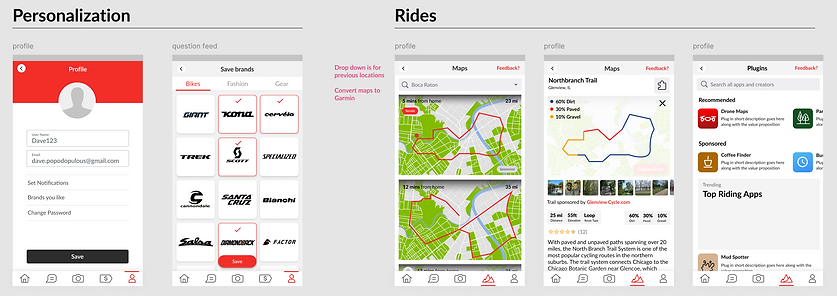
Bike route apps are also fragmented and it was hard to find an app that gave directions from my front door. A future feature is to introduce routes and trails in your community and near home.
Execution
Design & Research
I designed both iOS and Android versions. I sourced icons, crafted the UI, and ensured branding stayed cohesive. I interviewed fellow cyclists of what they wanted from the app as one feedback loop. It wasn't consistent and an area I should have performed more routinely.

For some cyclists, upgrading equipment is an obsession. I created a design for plug-in for cyclists to create a shopping or wishlist used across bike cycling marketplaces. The products saved to the list help us learn what each customer likes so we can recommend those products if available in the inventory or promote being an Amazon affiliate.
Engineering
Our first development partner cost twenty four thousand dollars and delivered mediocre code. Slow workflows. Boot camp level contributors. Missing quality. They eventually fired us because I demanded higher standards. Fine. We moved on.
I found Ziad through a friend. He rebuilt the app the right way. Fast, thoughtful, reliable. Total spend reached roughly thirty to thirty five thousand dollars. We got a functional app accepted into Apple and Android stores.

Marketplace Building
We needed supply first. We pulled listings manually from Facebook and Craigslist, added them to Pedals, and reached out to sellers explaining we were a complementary marketplace - sellers were delighted that we reached out to them and that they item was being seen by more people.
Then we chased demand.
• I leveraged my cycling group and QR code jersey
• We tested paid ads on Instagram and Facebook
• We attempted content marketing with outsourced blog posts, fired the vendor after poor quality, found another the did a great job then she ghosted us.
Hands on outreach worked. Nothing scaled.

I dove head first into the cycling and join the TLEN team - I was way over my head, but through consistent practice, I gained strength and endurance.

Reposting other cyclists content brought us exposure converting into followers.
Results
What worked:
• The app was fast, intuitive, and visually strong
• Early riders validated the concept and appreciated the simplicity
• Outreach to sellers succeeded in populating the app
• The engineering rebuild produced a reliable product
What failed:
• The supply and demand sides did not scale
• The team lacked aligned effort and speed
• Marketing had shallow funding
• Monetization required payment tooling we could not afford to build early
• Investors questioned the founder alignment and commitment
After three years, we made the hard call to shut the business down.
Reflection
I would never again take on co-founders who cannot match my pace or commitment. Good people are not enough. I need killers who move and build.
I underestimated the capital needed for marketplace marketing and product validation. I did not underestimate the product complexity but I underfunded the tools required to test demand at scale.
If I build another marketplace, I will start with a funded team, clear ownership of responsibilities, and real operational speed. I am proud of how much I built and learned and joining a community that I love and lead me back to my athlete roots. End to end experience with design, engineering, funding, pitching, validation, and shutdown changed how I approach product and leadership.
Strategic Design Leadership
Design Intrapreneur: Turned a fragmented bike buying ecosystem into a fully realized marketplace concept, rapidly prototyping and shipping end to end experiences while navigating weak co founder output and inconsistent engineering resources.
Design Visionary: Defined a long term platform vision built on Blue Ocean strategy, elevating the product beyond listings into AI powered concierge services, rich rider identities, bundled commerce, and integrated route discovery to create a differentiated cycling ecosystem.
Strategic Unifier: Aligned engineering, marketing, community outreach, and supply side acquisition into a coherent operating model, building trust with riders, sellers, and investors while carrying business modeling, pitching, and product leadership to move the venture forward.